One team, one service, one roadmap. Here's the whole system on one page.
Every example below runs on the same made-up Oregon DMV service, so the pieces connect and you can see how one thing becomes the next.
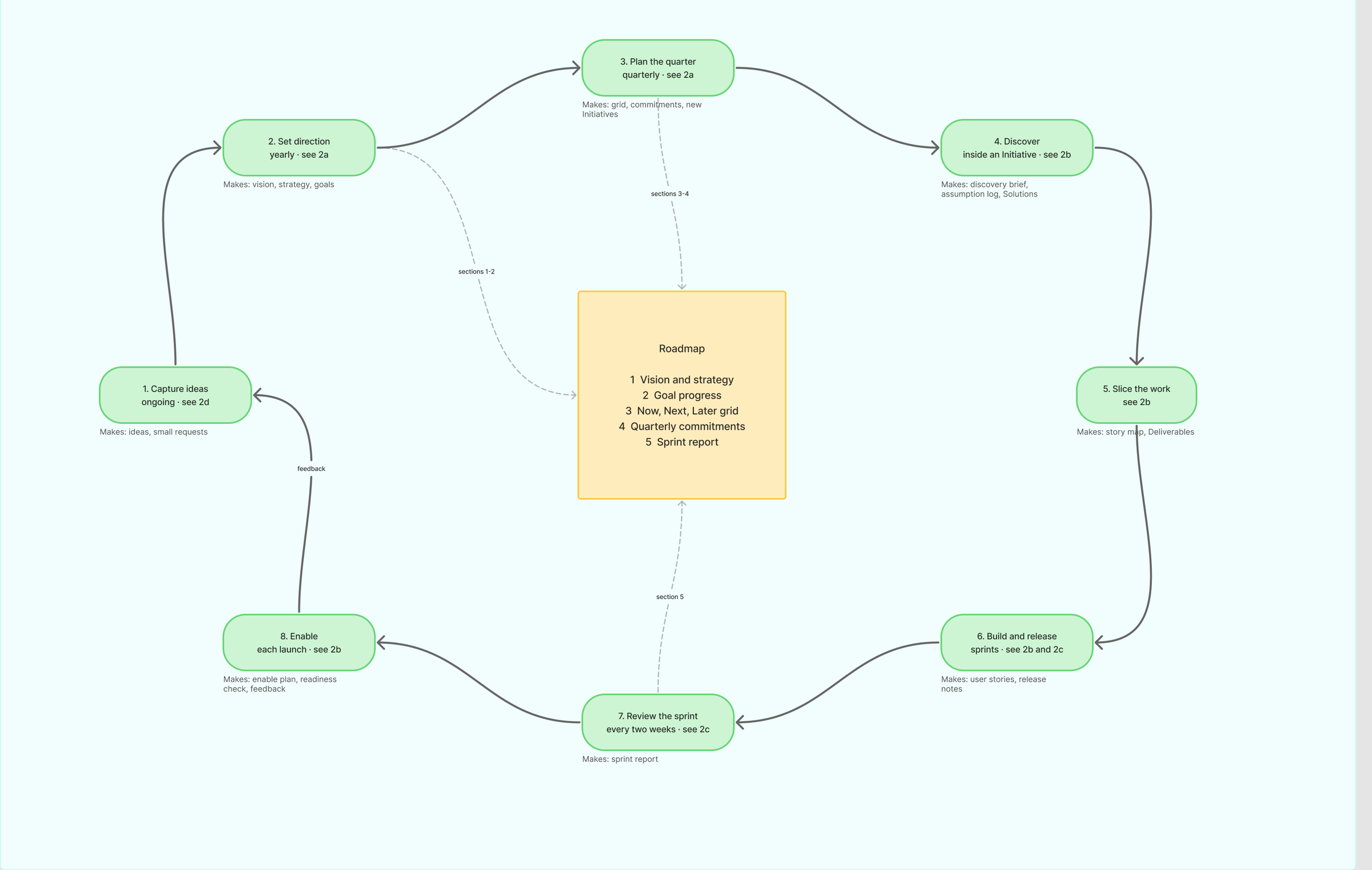
From the board, where the whole system is drawn chapter by chapter.
- 1Capture ideasRequest triage and the idea logSmall request · Idea
- 2Set directionVision and strategy, Goals and goal progressRoadmap · Goal
- 3Plan the quarterQuarterly planning and commitments, Now, Next, Later grid, Initiatives and solutionsRoadmap · Initiative · Solution
- 4DiscoverDiscoveryDiscovery brief · Assumption log
- 5Slice the workDeliverables and user storiesDeliverable · Epic (optional) · User story
- 6Build and releaseBuild, release and enableLaunch readiness check · Release notes · Enable plan
- 7Review the sprintSprint reportSprint report
- 8EnableBuild, release and enableLaunch readiness check · Release notes · Enable plan
The files. Blank template plus a filled DMV example for each.
- RoadmapQuarterly; sprint report each sprint
- GoalYearly
- IdeaOngoing
- Small requestOngoing
- InitiativeOpen until the outcome is reached
- SolutionAs tried, kept or dropped
- Discovery briefEach round of discovery
- Assumption logDuring discovery
- DeliverableCommitted quarterly
- Epic (optional)As the team needs
- User storyEach sprint
- Sprint reportEach sprint
- Release notesEach release
- Launch readiness checkEach launch
- Enable planEach launch
The practice sessions. Each one taught the week before the team first uses it.
- 4Practice: request triageHow Requests Are ReviewedFor the people who run triage. Leaves behind: Every request gets an answer within five business days.16 slides
- 5Practice: mapping and slicingHow We Map and Slice the WorkFor product owner, UX, developers. Leaves behind: Candidate Solutions arrive in pieces small enough to size.16 slides
- 6Practice: quarterly planningHow We Plan the QuarterFor the whole team. Leaves behind: A plan the team believes it can keep, and the habit of making one.19 slides
- 7Practice: sprints and the sprint reportHow We Run a SprintFor the whole team. Leaves behind: Ready stories, a sprint goal, and a sprint report everyone can read.21 slides
- 8Practice: discoveryHow We Learn Before We BuildFor the product trio. Leaves behind: A discovery brief with a decision in it.17 slides
All eight decks, in the order a team hears them, including the three that bring leaders, partners and the team along.
Then: what AI changes about the team and the prompts that do it. How to adopt it in one quarter. What broke when it was used.
What broke when it was used
- One early planning week gave the technical maintenance session an hour, and the foundation slipped. The session is now a half day and the rule is don't skip it. Planning deck, slide 8.
- A team that went through this before had no written definition of ready, no definition of done and no sprint goal, so the gaps were agreements nobody had written down, not effort. Sprint deck, slide 2.
- The first quarter can miss. Teams new to planning don't know how to commit yet, and committing is how they learn; the fix is to say what isn't ready, not to skip committing. Leading the change.
Documents
- 00GlossaryDraft
- 01Shared terms and artifactsDraft
- 02Why digital servicesDraft
- 03Vision and strategyDraft
- 04Goals and goal progressDraft
- 05Now, Next, Later gridDraft
- 06Quarterly planning and commitmentsDraft
- 07Sprint reportDraft
- 08Request triage and the idea logDraft
- 09Initiatives and solutionsDraft
- 10DiscoveryDraft
- 11Deliverables and user storiesDraft
- 12Build, release and enableDraft
- 13Team rhythmDraft
- 14Roles and decision rightsDraft
- 15Leading the changeDraft
- 16Agent setupLater
- 17Reference libraryNot yet drafted
All of this came out of years of doing it inside government, after a long stretch doing it in a software company, and then relearning it with AI. The story of how is here, if you want it. It's not required reading.