The system01Draft
Shared terms and artifacts
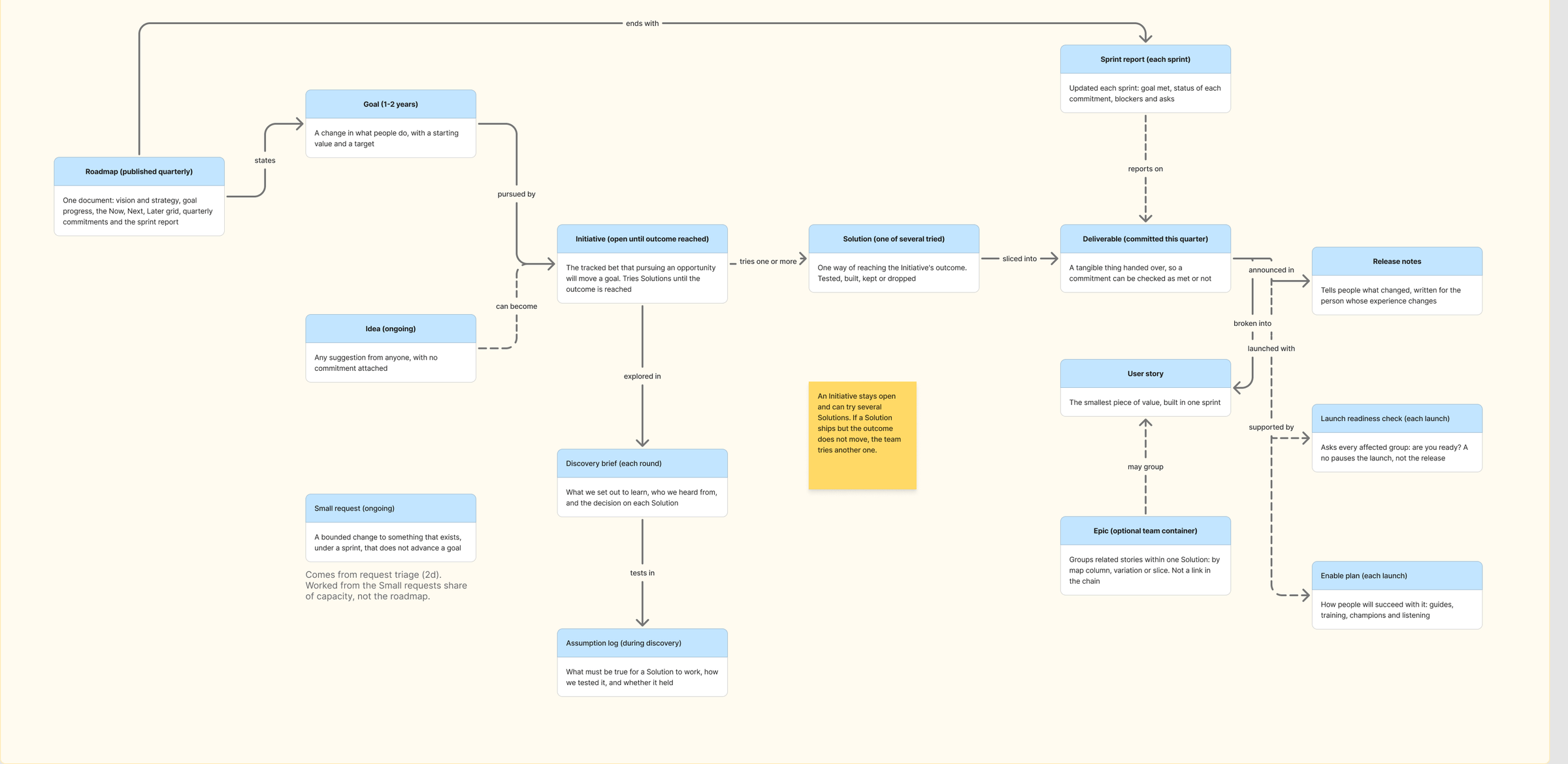
This page names the artifacts we write and shows how each one leads to the next, so a counter clerk's idea can be traced all the way to the release note that tells her it shipped.
When
- Read it when you join the team and before you write your first artifact.
- Come back when two people use one word for different things. Settle it here, then fix the other documents.
- Review it each year at the direction review.
Who
- Product manager owns this document and the roadmap.
- Everyone on the team uses these terms in artifacts, meetings and replies to requesters. So do AI agents working with the team.
The artifact chain
An artifact is anything the team generates as part of designing, building and running a service, made to be used and built on by the next step. The artifacts below connect in a hierarchy, so daily work can be traced back to goals.
| Artifact | What it is | Owner | Usual horizon | Format sentence |
|---|---|---|---|---|
| Idea | Raw input from anyone, no commitment | Product manager owns the idea log; anyone adds | None | None. Use the submitter's words |
| Initiative | The tracked bet that pursuing an opportunity will move a goal. Holds its Solutions | Product manager | Later until active; then shown through its Solutions and Deliverables | We believe [problem space] represents an opportunity to advance [goal] by [approach hypothesis]. |
| Solution | One way of reaching the Initiative's outcome, tested, built, kept or dropped. An Initiative may try several | Product manager decides; product owner helps scope | Next (its slice for this quarter shows in Now as a Deliverable) | [Solution] will enable [user group] to [do something], which we expect to move [the Initiative's outcome]. |
| Deliverable | A tangible thing handed over, so a commitment can be checked as met or not. On the roadmap, a slice of a Solution scheduled this quarter | Product manager schedules; product owner runs delivery | Now | None. Use concrete delivery language |
| User story | The smallest piece of user value, finished in one sprint | Product owner writes; development team estimates | None | As a [user type], I need to [action], so that I can [benefit]. |
| Release notes | Internal and external messages that close the loop on a Deliverable | Product owner; product manager for Solution launches | None | None. Lead with the benefit |
| Goal | A change in what people do, with baseline and target, held one to two years | Executive steering group with the product manager | One grid row per goal | By [timeframe], [user group] will [behavior change], measured by [metric], creating [community value]. |
Epics sit outside the chain. They are optional containers the team uses to group stories within a Solution, in whatever shape helps (see the Glossary). A story always links to its Deliverable; it may also belong to an epic.
The roadmap is the one document that pulls these together. It links to the artifacts and doesn't rewrite them.
The roadmap
| Section | Holds | Changes |
|---|---|---|
| Vision and strategy | Vision; diagnosis, guiding approach, 3-5 key actions, tradeoffs | Yearly |
| Goals and goal progress | Up to three goals and the progress table | Goals yearly, progress quarterly |
| Now/Next/Later grid | Initiatives, Solutions, Deliverables | Quarterly |
| Quarterly commitments | Deliverables and ongoing commitments, intended progress per goal | Set quarterly, status each sprint |
| Sprint report | One row per sprint | Each sprint |
Definitions
Every term, including the words we avoid, is defined in the Glossary. This page shows how the artifacts connect; the glossary says what each word means.
Trace any piece of work. Each row links to the one above.
| Artifact | Name | Links to | Lives in | Status |
|---|---|---|---|---|
| Idea | Requester, date | Idea log | ||
| Initiative | Ideas, goal | Initiative artifact | ||
| Solution | Initiative | Initiative's Solutions list | ||
| Deliverable | Solution | Quarterly commitments | Committed / On track / Off track / Done | |
| User story | Deliverable (and epic, if the team uses one) | Sprint | ||
| Release notes | Deliverable | Sent to |
Rules of thumb
- If you can't name it specifically, you don't understand it well enough to put it on the roadmap.
- One item, one column. "Phase 1" in Now, "phase 2" in Next and "phase 3" in Later is one item pretending to be three.
- Lightweight capture, rigorous connection. Ideas cost nothing to log. Everything after an Idea links to its parent.
- If work won't fit the user story format, you probably haven't found the right artifact yet.
- Link, don't copy. Artifacts point at research and specs. They don't repeat them.
On the board