The system03Draft
Vision and strategy
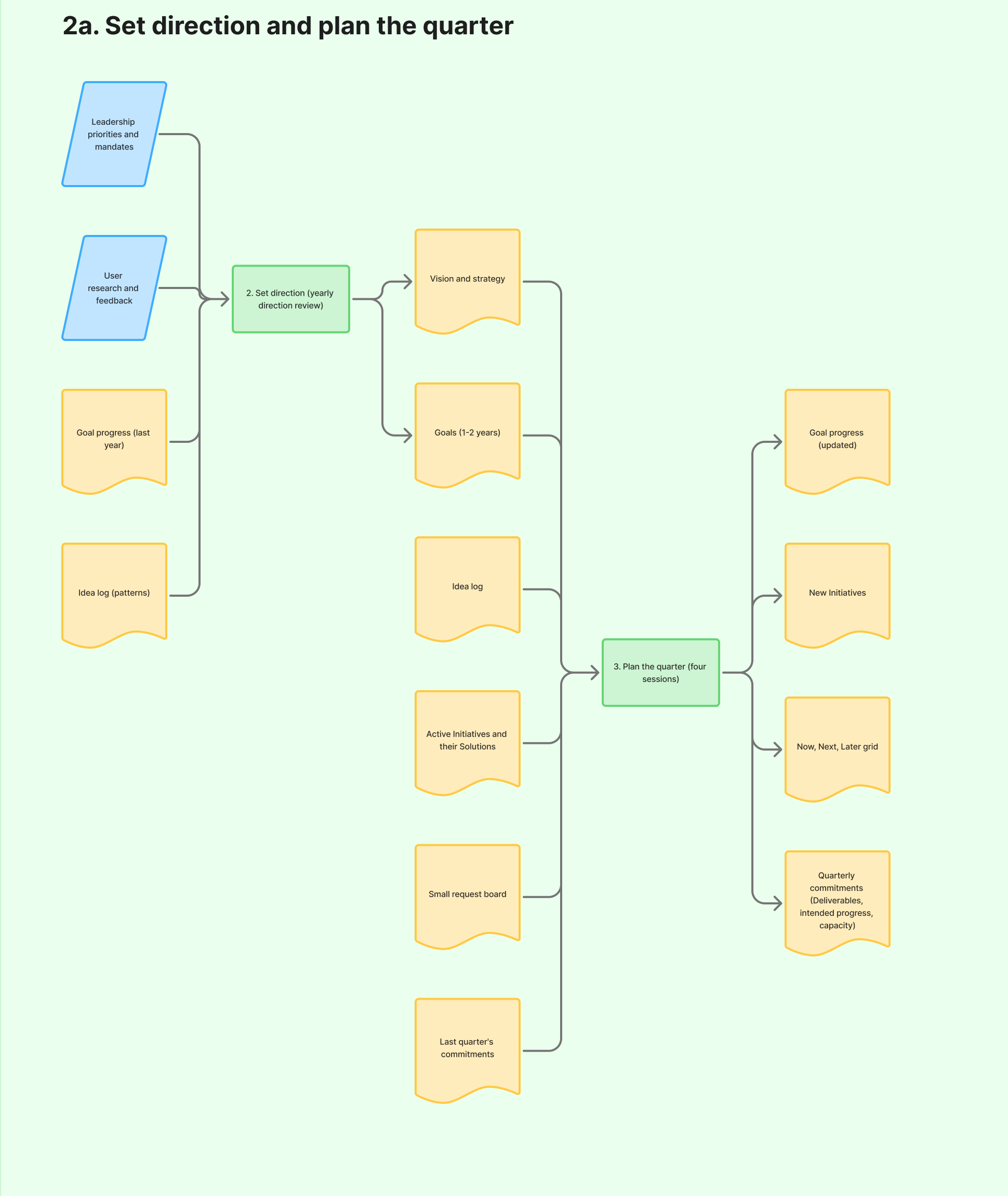
Vision and strategy is the first section of the roadmap. The vision describes life for the people we serve once this digital service has done its job. The strategy is our theory of how to get there from where we are now, and it is the compass we use when we have to choose between competing pieces of work.
When
- Written once, when the service is conceived. This happens in step 2 of the process flow, Set direction, after the group has answered "Is this a service?"
- Reviewed yearly at the direction review. Hold the review ahead of budget requests so that funding asks follow the strategy. The goals for the year are set at the same meeting (see Goals and goal progress).
- Checked every quarter at quarterly planning. The product manager opens planning with this section and uses it to filter candidates. The section isn't rewritten each quarter.
- Different parts change at different speeds. The vision covers five years or more and should outlast a new director or a new set of elected leaders. The strategy holds for two to five years. Key actions get refreshed at the yearly review as they finish.
Who
- Executive steering group owns the vision and strategy and approves them. The team works out how to deliver.
- Product manager facilitates and leads: runs the workshops, drafts the text, brings the evidence and keeps the section current in the roadmap.
- Advisory group brings what the community and partner agencies see. They check that the diagnosis matches what they live with.
- UX designer and researcher bring research findings, so the diagnosis rests on more than opinions.
- Technical architect separates real technical constraints from habits and checks that each key action can actually be done.
- Development team and content strategist review the draft. When it's done, everyone on the team should be able to explain the vision in their own words.
How it works
- Ask "Is this a service?" Before anyone writes a vision, leadership, the product manager and key stakeholders agree that there is a digital service that needs to exist for the community or for staff. That means there are people with an ongoing need, no finish line, and work that will keep changing. If the honest answer is a one-time fix, run it as a project and skip this section.
- Write the vision. Describe a "sci-fi future" five or more years out. Write about what people can do and how their lives are different. Leave out metrics, technology names and current constraints. Make it specific to the digital service: it should be clear that it describes this service and no other. Aim higher than "as easy as the private sector." Government can set the standard rather than catch up to it.
- Diagnose the problem. Name what is systematically broken about how we serve people today. Look for patterns and root causes rather than a list of complaints. Ask where the service is designed around government needs instead of user needs. Separate artificial constraints (process and habit) from real ones (law, budget, security). Draw on research, the idea log and staff experience. In Richard Rumelt's terms, a good diagnosis makes a complicated situation simpler by naming the part that matters most.
- Set the guiding approach. This has two parts:
- Guiding principles are how we choose. Write them as decision rules, for example: "When choosing between competing initiatives, we'll prioritize..." and "Our approach to balancing compliance and user experience will be..."
- Focus areas are where we play. Name the user journeys and kinds of problems that get concentrated attention. These are areas to investigate, not solutions. A.G. Lafley and Roger Martin call this choosing where to play and how to win.
- Pick 3 to 5 key actions. These are the big moves that put the guiding approach to work. Cover technology, staff, process and politics. Rumelt calls these coherent actions, meaning each one makes the others stronger. Check every pair: does this action depend on or strengthen that one? The specific Solutions and Deliverables belong in the Now, Next, Later grid, not here.
- Name the tradeoffs. Say what we will not do, defer or ignore so that the focus holds. If no one in the room winces at a tradeoff, it isn't a real choice.
- Test, approve and publish. Run the strategy tests (see Rules of thumb). The steering group approves the result, and the product manager puts it at the top of the roadmap.
- Use it. At quarterly planning, any candidate that doesn't trace to a focus area or a key action needs a stated reason, such as a mandate, technical maintenance or a small request. At weekly triage, the tradeoffs supply the reason behind a "will not do."
Template
Use Roadmap, section 1, Vision and strategy.
DMV example
The filled DMV vision and strategy is in Roadmap (DMV example, section 1).
Each key action depends on another. Renewal can't serve everyone without staff ready for the cases that remain. The first-license journey can't reach a single trip without shared identity verification. Staff satisfaction rises only if renewal actually removes routine work from the counter. Take any one action away and the others weaken. That is the coherence test working.
Rules of thumb
- Strategy tests. Run these before approval and again at each yearly review:
- Will this guide decisions even when technology changes?
- Will this help us choose between competing initiatives?
- Does this explain why we're heading this way, not what we'll build?
- Could this still apply in three years with different initiatives?
- Do the key actions reinforce each other, or are they a list?
- Would a reasonable person disagree with at least one tradeoff?
- A list of things to build is not a strategy. If the section reads like a portfolio, ask whether it would help you choose an initiative no one has thought of yet. Move anything concrete down to the grid.
- A goal is not a strategy. "75% of renewals online" is where we want to land. Strategy explains why we believe our approach gets us there. Rumelt calls the confusion between the two bad strategy.
- Watch for internal focus. Every principle should connect to a better outcome for residents or the staff who serve them. If one only makes government's job easier, rewrite it.
- Hold the vision steady. A vision that changes with each administration is a slogan. Change the strategy when the diagnosis changes, not when the mood does.
Files for this chapter
Blank template plus a filled DMV example for each.
On the board