The system08Draft
Request triage and the idea log
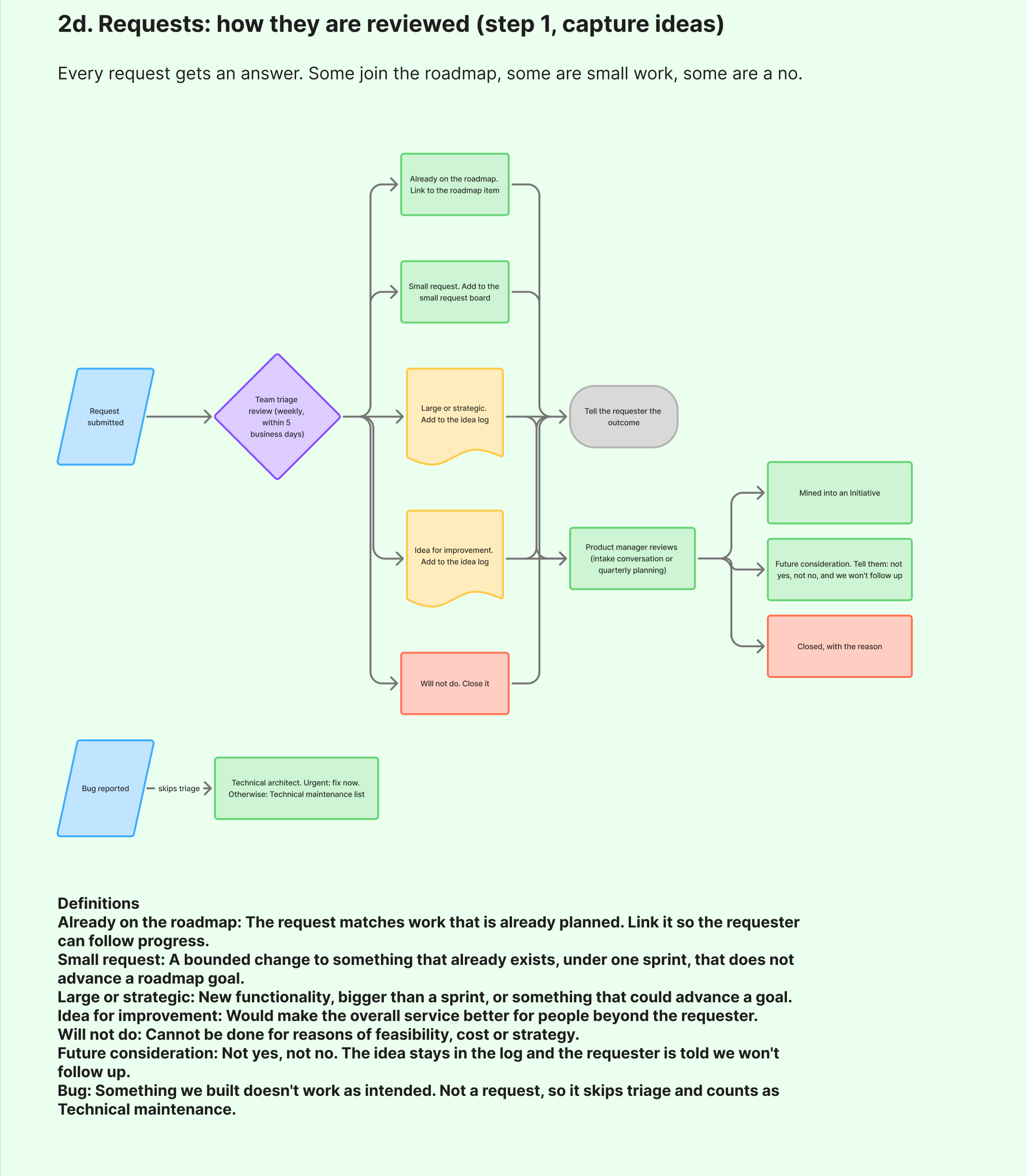
Requests reach the team every week, from staff, partners, leadership and the public. Triage gives every request a clear outcome within five business days and tells the requester what happened, so small fixes get done, big ideas are kept, and the roadmap stays focused on goals.
When
- Weekly. The team holds a triage review once a week. Every request submitted since the last review gets an outcome.
- Within 5 business days. No request waits longer than that for a decision.
- Quarterly and yearly. The product manager mines the idea log at quarterly planning (step 3, Plan the quarter) and at direction setting (step 2, Set direction). Triage is where requests come in. Planning is where the ideas get used.
Who
- Product owner runs the triage review, owns the small request board (and steps in to change its order when priorities shift), and sends or delegates the reply to each requester.
- Product manager owns the idea log, makes the call on "already on the roadmap" and on "will not do" for strategy reasons, and mines the log for patterns.
- Content strategist brings requests from editors and partners, explains the context, and argues for the requests that matter most to them.
- Technical architect or a member of the development team flags anything that may be infeasible or bigger than it looks.
- Technical architect also owns bugs, which are Technical maintenance, and puts them in priority order with the Technical maintenance list.
- Requesters don't attend. They get a reply.
How it works
- Request submitted. Anyone can submit, through the intake form or through a content strategist. One request per submission, written in the requester's own words.
- Team triage review. At the weekly meeting, the team reads each request and gives it one of five outcomes:
| Outcome | Test | Where it goes |
|---|---|---|
| Already on the roadmap | The roadmap already covers it as an Initiative, Solution or Deliverable | Link to the roadmap item |
| Small request | Changes something that already exists and can be finished in less than one sprint | Small request board |
| Large or strategic | New functionality, or more than one sprint of work | Idea log |
| Idea for improvement | Would improve the service for people beyond the requester | Idea log, tagged separately |
| Will not do | Fails on feasibility, cost or strategy | Closed, with the reason |
-
Tell the requester. Every request gets a reply, whatever the outcome. If nobody hears back, the next request goes around the system as a hallway ask.
-
Large requests get a conversation. When a large or strategic request comes from a partner who needs an answer, the product manager meets the requester before the idea sits in the log. See the intake conversation below.
-
The product manager decides what happens to each idea. At the intake conversation or at quarterly planning, an idea in the log moves out of Needs review to one of three statuses: Mined into an Initiative, Future consideration, or Closed.
Ideas for improvement stay separate from large or strategic ideas because at triage we don't know their size. Once someone looks closer, an improvement idea may turn out to be a quick fix or a whole new Initiative. If a request is a clear, bounded fix to something that already exists, call it a small request even if other people will benefit too.
Bugs skip triage
A bug is something we built that doesn't work as intended. It isn't a request, because nobody is asking for a change. Bugs go to the technical architect and count as Technical maintenance. Anything that stops people using the service, exposes data or creates a security hole is fixed now, without waiting for the weekly review. Everything else joins the Technical maintenance list in priority order. If a "bug" is really a request for different behavior, send it back to triage.
The large request intake conversation
A large request from a partner usually arrives as a solution with a deadline attached: "we need a portal by July." Before it goes in the log, the product manager meets the requester, with the UX designer and researcher if possible, and works through five questions:
- Is the problem clear, rather than a solution? Ask what happens today, who it affects and what goes wrong. If nobody can say, the first step is discovery, not a decision.
- Is there a hard deadline? Separate a mandate (law, policy, funding) from a wish. A real mandate makes it Required work, which still competes for capacity at planning.
- Do we need more discovery? If the problem is real but unclear, hand it to the UX designer and researcher as a discovery candidate for planning.
- Can the scope be reduced? Sometimes a smaller version solves most of the problem and fits as a small request now.
- Does the partner understand how we work? Explain the quarterly cycle: what can happen this quarter, what waits for planning, and what they will hear and when.
The conversation ends in one of five places: a candidate Initiative or discovery item for the next quarterly planning, Required work for planning with its mandate attached, a small request, Future consideration, or will not do. Whichever it is, the partner leaves knowing what happens next and when they will hear.
Future consideration: not yes, not no
Some ideas are worth keeping but don't fit the strategy or capacity now, and nothing tells us when they will. Future consideration is the status for those. It tells the requester three things plainly: we aren't saying yes, we aren't saying no, and we won't get back to you. The idea stays in the log, and if it fits a future quarter the product manager will find it there. The requester can always ask again, especially if something changes on their side.
The status exists because the alternative is silence, and people read silence as a forgotten yes or a quiet no. Either way they keep waiting or keep asking. Saying "we won't follow up" once is kinder than leaving them to guess.
Small requests are a capacity bucket, not roadmap work
Small requests get a fixed share of team capacity, 25% by default, set each quarter at planning. The product owner owns that share. The team works the board kanban style, first in, first out: requests are pulled into each sprint in the order they arrived, as capacity allows. Urgency can move a request up the line, and the product owner can step in to change the order when priorities shift. The product manager doesn't plan small requests. Individual requests never appear as grid items; only the Small requests capacity row does. As one of our own planning notes says: "it's not a road mapping activity."
When several small requests point to the same problem, the content strategist or product owner adds that pattern to the idea log. The requests themselves stay small requests.
The idea log is a toy chest
An Idea is unstructured capture with no commitment attached. Logging an idea promises the requester only that it won't get lost. The product manager mines the log at direction setting for patterns that might shape strategy, and at quarterly planning for candidates to frame as Initiatives. Most ideas never become Initiatives, and that is expected.
1. Requester reply (one per outcome)
Already on the roadmap:
  Thanks. This is already part of [roadmap item]. You can follow progress here: [link].
Small request:
  Thanks. This is on our small request board. We work these in the order they arrive,
  unless something is urgent, and expect to get to it within [typical time]. We'll
  tell you when it's done.
Large or strategic:
  Thanks. This is bigger than a quick fix, so we've added it to our idea log. We
  review the log every quarter when we plan. We can't promise a date.
Idea for improvement:
  Thanks. This could help more people than the original ask, so we've logged it as
  an improvement idea. We'll look at it more closely when we plan next quarter.
Will not do:
  Thanks. We won't be taking this on because [feasibility / cost / strategy reason].
  [Alternative, if there is one.]
Future consideration (after the product manager reviews an idea):
  Thanks. We've looked at this and it doesn't fit what we can take on now. We're
  not saying yes and we're not saying no. It stays in our idea log, and we'll come
  back to it if it fits a future plan, but we won't be following up with you. If
  something changes on your side, please tell us.
2. Small request board: columns Ready (first in, first out) → In sprint → Done → Requester told. Card fields are in Small request.
3. Idea log: entry fields and statuses are in Idea.
Rules of thumb
- Every request gets an answer. A "no" with a reason builds more trust than silence. So does "not now, and we won't follow up."
- Meet the requester before a large request goes in the log. Most arrive as solutions, and the problem underneath is usually smaller or different.
- Small requests belong to the product owner. If the product manager is ordering the small request board, the bucket has turned into a second roadmap.
- Log ideas freely and promise nothing. The idea log is a toy chest, not a queue, and nobody should read "logged" as "scheduled."
- Patterns go up and requests stay put. Twelve requests about the same problem make one idea for the product manager, but the twelve requests stay small requests.
- Don't score requests at triage. A weighted scoring model ((impact + strategic fit − effort − risk) × confidence) can help compare large candidates at quarterly planning. A value/effort 2x2 (high value, low effort: do now; high value, high effort: do next; low value, low effort: do later; low value, high effort: don't do) can help sort the idea log. Neither belongs in a 30 to 45 minute weekly meeting.
- Leave internal users' convenience out of the roadmap. Editors and staff matter, but most of their asks are small fixes. Roadmap goals are about the people the service exists for.
Files for this chapter
Blank template plus a filled DMV example for each.
Taught in
- A New Way of Working · Partner introduction, 30 slides
- How Requests Are Reviewed · Practice: request triage, 16 slides
On the board