The system10Draft
Discovery
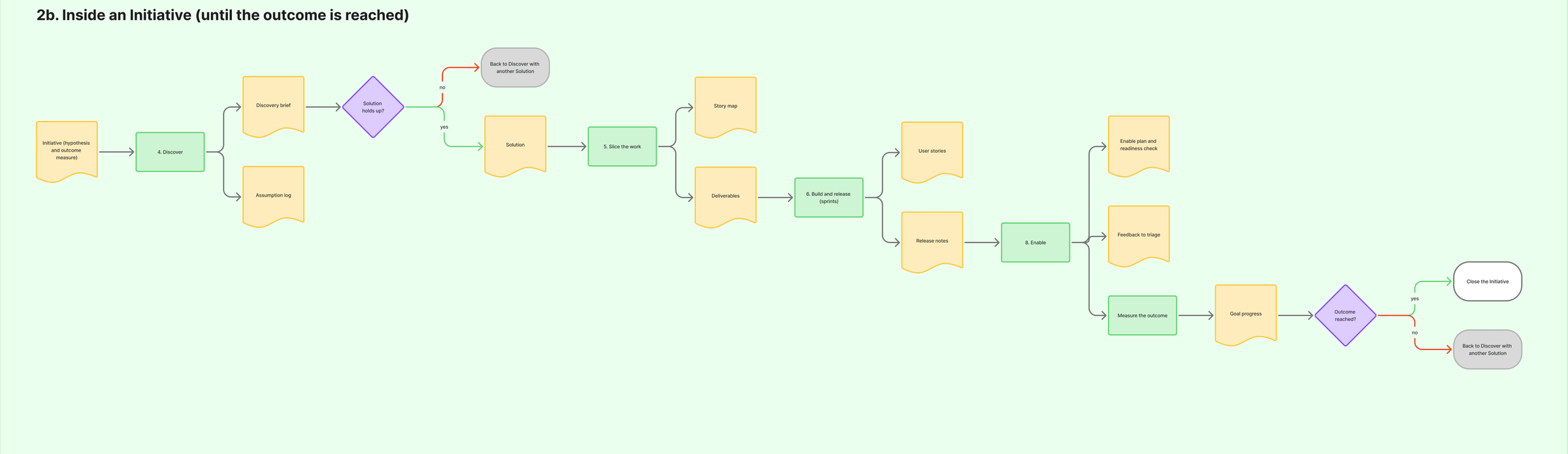
Discovery is the learning work inside an Initiative. It is how the team finds which problems are worth solving and which Solutions actually work, before it spends delivery capacity on them. It doesn't end the Initiative: when one Solution fails, discovery tries the next.
When
- Step 4 of the process flow. It starts when quarterly planning makes an Initiative active, and it comes back whenever a Solution fails or the outcome stops moving.
- Timebox each round. Most rounds need four to eight weeks, and none should need more than a quarter. If the timebox runs out, decide with what you know.
- Discovery effort comes out of the Strategic share of capacity, the same as building.
- Listening does not stop once a Solution ships. Keep a weekly habit of talking to users so the next Initiative starts with evidence.
Who
- Product manager owns the Initiative, the brief and the decision.
- UX designer and researcher plans the research, runs listening sessions and builds the maps.
- Technical architect and one or two people from the development team check feasibility early and run technical tests. The product manager, the designer and an engineer form the product trio, which stays together from the first session until the first slice is ready.
- Content strategist joins when the problem involves instructions, forms or wording.
- Product owner takes the story map into slicing.
- Advisory group reviews what was learned. The executive steering group sees the decision in the roadmap.
How it works
- Pick the outcome. Begin with a goal from the roadmap, stated as a change in behavior you can measure. Don't begin with a feature. If the Initiative can't name the goal it advances, send it back. (Melissa Perri: outcomes over outputs. Teresa Torres: the desired outcome is the root of the tree.)
- Plan the research. Write the questions you need answered to reduce risk. A research plan lists questions, not features. Choose who to talk to by how they behave and think, not by demographics. (18F: research before you build. Erika Hall, via the reference research plan.)
- Listen to people. Run one-on-one listening sessions. Ask people to walk through the last time they did the thing. Write down their words, especially verbs and feelings. Don't pitch ideas. Talk to the staff who serve them too. (Indi Young: listening sessions. Torres: interview about specific past stories.)
- Map opportunities. Sort what you heard into goals, priorities, tasks, motivators and barriers. Barriers are where most opportunities hide; name the top three. Draw a mental model map of the user's world, then mark where nothing helps them today. Each gap is an opportunity: an unmet need, pain or desire, phrased the way a user would say it. An opportunity is not a feature request. Choose one target opportunity. (Young: mental model map. Torres: opportunity mapping.)
- Generate several solutions per opportunity. Come up with at least three for the target opportunity before you pick one. Hang them on the opportunity solution tree in four levels: outcome, opportunity, solution, test. (Torres: opportunity solution tree. Perri: solution exploration.)
- Test assumptions. For each serious solution, list what must be true for it to work: people want it (desirable), it moves the goal (viable), we can build it (feasible), people can use it (usable). Test the riskiest ones first, as cheaply as possible. Good options are a staff log, a paper or click-through prototype, a concierge test where people do by hand what the software would do later, or a short technical spike. Record each one in the assumption log. (Torres: assumption testing. Perri: concierge and Wizard of Oz experiments, the Product Kata. 18F: prototype several concepts quickly.)
- Decide. Each Solution tested gets one of three results: build it, don't build it, or try something different. Write down the reason in the Initiative's Solutions field. A "don't build" decision is finished work, not a failure, and the Initiative carries on with its next option.
- Move into slicing through a story map. The trio and the product owner map the Solution's backbone, the steps the user takes from left to right. They then slice off a first release, plus a learning slice that tests the riskiest remaining assumption with real users. That map feeds step 5, Slice the work. (Jeff Patton: story mapping, slicing for release and for learning.)
Template
Two artifacts. The brief is one page and lives with the Initiative. Research notes, maps and the tree are linked as evidence, not copied into the brief.
Use Discovery brief and Assumption log.
DMV example
The filled DMV discovery brief for Single-trip new driver licenses is in Discovery brief, and its four assumptions are in Assumption log. The round in short: 12 listening sessions and a one-week counter log, three candidate Solutions, and a decision to build photo upload with staff review.
A3, the self-serve checklist, broke in testing: 3 of 5 applicants picked the wrong birth certificate type. That is why staff review is part of the Solution and the checklist is not enough by itself.
Rules of thumb
- A Solution in discovery is low commitment and high learning. Don't give a delivery date before the decision is made.
- Three solutions or you're not done. If the team can name only one, it hasn't explored the opportunity yet.
- Test the assumption that would hurt most if it were wrong, and use the cheapest test that would change your mind. A week of staff tally marks often beats a month of building.
- Keep a developer in the room. Feasibility found in week one is cheap. Found in sprint four, it costs a lot.
- Link research, don't paste it. The brief holds the decision and the evidence trail on one page.
- Timebox it. Discovery with no decision date turns into endless research.
Files for this chapter
Blank template plus a filled DMV example for each.
Taught in
- How We Learn Before We Build · Practice: discovery, 17 slides
On the board