The system09Draft
Initiatives and solutions
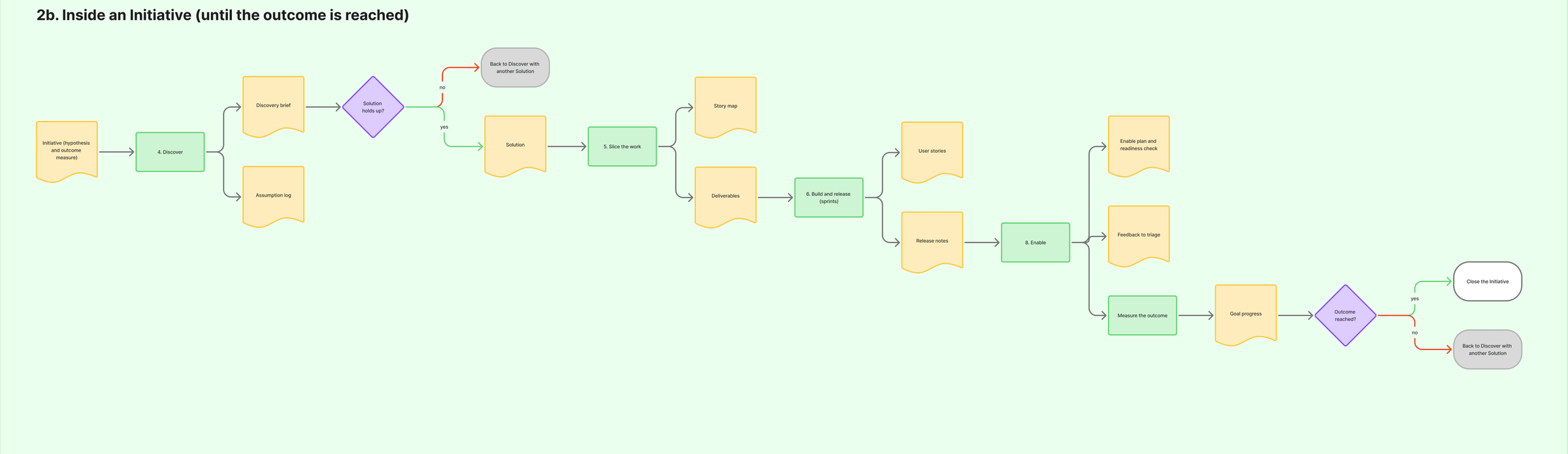
An Initiative is the thing we track: a bet that pursuing an opportunity will move a goal, held to the outcome it is meant to change. Solutions are the outputs the team tries along the way, tested, built, kept or dropped. We care about the outcome, not any one Solution, so an Initiative has room to try different ways until one works.
When
- Initiative. Write one when ideas in the idea log start to cluster, or when a goal points at a problem nobody has looked at closely. Most are written at quarterly planning. An Initiative stays open until its outcome is reached or the team decides the bet was wrong. That can take several quarters.
- Solution. Write one whenever the team has a way it wants to try. Several can exist under one Initiative: some tested and dropped, one being built, another on hold until a dependency is ready. A Solution can be as small as a paper prototype or as large as new software.
- Close an Initiative when the outcome is reached, or when the evidence says the opportunity isn't worth more effort. Record what was learned either way.
On the Now, Next, Later grid, an Initiative that hasn't started sits in Later. Once it is active, it shows up through its work: the Solutions planned for the next two quarters in Next, and this quarter's Deliverables in Now. Every card names its Initiative.
Who
- Product manager owns the Initiative: the hypothesis, the outcome measure and the call to keep going, change direction or close it.
- UX designer and researcher plans and runs discovery and links research as evidence.
- Technical architect checks feasibility, sizes Solutions and names technical dependencies.
- Development team sizes Solutions before any slice is committed.
- Product owner helps scope each Solution so the team can slice it into Deliverables.
- Content strategist joins when the problem lives in instructions, forms or rules people have to read.
- Advisory group checks strategic fit before an Initiative starts.
- Executive steering group sees Initiatives on the roadmap and approves the resources to pursue large ones.
How it works
- Frame the Initiative. Write the hypothesis: "We believe [problem space] represents an opportunity to advance [goal] by [approach hypothesis]." Name the outcome measure that will tell you it worked, tied to the goal. Say who has the problem and how often.
- Explore. Discovery maps the opportunity and generates at least three candidate Solutions, each with the assumptions that must hold for it to work (see Discovery).
- Try the most promising Solution. Test its riskiest assumptions as cheaply as possible. A Solution that fails a test is dropped or changed, not defended. The Initiative carries on with the next option.
- Build what holds up. When a Solution survives testing, slice it into Deliverables and schedule them by quarter (see Deliverables and user stories).
- Watch the outcome, not the output. After each release, check the Initiative's outcome measure. If it isn't moving, the Solution may be wrong even if it shipped perfectly. Try another one.
- Close. End the Initiative when the outcome is reached or the bet is disproven. Both are finished work.
Template
Use Initiative and Solution.
DMV example
The filled DMV Initiative, Single-trip new driver licenses, is in Initiative: three Solutions, one dropped, one building and one on hold. Its second Solution, License Ready Check, is in Solution.
If the repeat-trip rate hasn't moved two quarters after the first slice launches, the Initiative doesn't end. The team goes back to its Solutions and tries Solution C, a real-time eligibility check at the counter, or a new one.
Rules of thumb
- Hold the Initiative to its outcome and let Solutions come and go. A Solution that shipped but didn't move the outcome is a lesson, not a success.
- Try the cheapest Solution first. A Microsoft Form or a paper checklist can answer the question before anyone builds software.
- Don't defend a Solution. Defend the outcome.
- A closed Initiative is finished work, whether the outcome was reached or the bet was disproven. Write down what you learned so nobody pays for the same lesson twice.
- Link research instead of copying it in. These artifacts hold decisions, and research reports hold findings.
Files for this chapter
Blank template plus a filled DMV example for each.
On the board