Practice: sprints and the sprint report
How We Run a Sprint
For the whole team. What it should leave behind: Ready stories, a sprint goal, and a sprint report everyone can read. Run it the week before Sprint 1 planning.
Teaches 07 Sprint report, 13 Team rhythm, 11 Deliverables and user stories, 12 Build, release and enable.
21 slidesDownload the PDF
Where the gaps were, the two-week rhythm, and who does what.
1Built from an earlier delivery team's process-changes deck (gap analysis, scrum roles, sprint goals, definitions of ready and done, refinement, spikes, sprint report) and that team's Q1 2024 planning deck (sprint budgets, the INVEST example), updated to system docs 07, 11, 12 and 13.
- 2
This is that team's scrum gap analysis, word for word. Run the same exercise with your team. The pre-sprint gaps are covered in the planning and story mapping decks; this deck covers the sprint and post-sprint columns.
- 3
From doc 13 Team rhythm. Every meeting should change something you can point to; the Updates line is that thing. If a meeting updates nothing and decides nothing, cut it or merge it.
- 4
From the Scrum Team Roles slide. If the team has no scrum master, spread those duties across the team. If the product manager and product owner are one person, keep the hats separate in your head.
The sprint goal and sprint budgets.
5One or two sentences about an outcome, not a list of stories. At review the answer is yes or no. The DMV goal names who can do what, where, and what is deliberately left out.
- 6
From that team's Q1 2024 planning deck: "Sprint budgets help to ensure that there is always a balance in the type of work necessary to maintain a healthy and innovative product." Two changes since: user requests are now worked first in, first out (the product owner can reorder), and the technical work is ordered by the technical architect.
Getting stories ready: INVEST, an example, refinement and spikes.
7Section break. The next four slides are about getting stories ready: INVEST, an example, refinement, and spikes.
- 8
INVEST is from the earlier team's deck. The checklist is the definition of ready in the user story template. The scrum master watches that stories move toward ready and that none come into a sprint that aren't.
- 9
From the earlier team's Q1 2024 planning deck, trimmed to the key INVEST points for each version. Walk left to right and ask the room which letter each version fails. A DMV version for practice: "As a first-time applicant, I need to submit a photo of my birth certificate before my visit, so that I can know it will be accepted without making a trip."
- 10
The five steps are from the earlier team's refinement slide. Refinement updates nothing on the roadmap; it fills the backlog under each Deliverable.
- 11
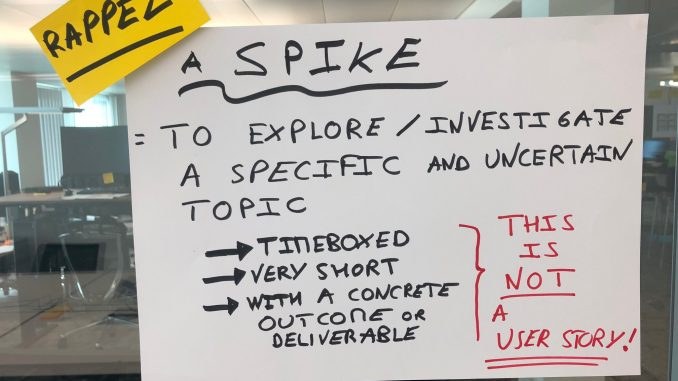
The whiteboard photo is from the earlier team's deck, which noted "need to adjust spike rules." The rule on this slide is the adjustment, from doc 11.
Definition of done, sprint review and the sprint report.
12Section break. Definition of done, sprint review, the sprint report and the retro.
- 13
The first two columns are from the earlier team's definition of done. The third is the definition of done in the user story template. Their software example had more items (SOLID refactoring, user manual); add what your team needs.
- 14
From doc 13. The review is where commitment status changes. Bad news goes up the same month, not at the end of the quarter.
- 15
The columns are the earlier team's sprint report (Sprint Goals, Goals Met, On Track, Unplanned Work, How to get back on track, Committed/Completed) plus the four status labels. One change: that report stayed inside the division; ours goes to the steering and advisory groups, because the sprint report is where they see commitment status between quarters.
- 16
The full Sprint 3 report is in the sprint report template. Point out the parts: a number, a reason, a recovery, who decides, and what happens if nothing changes.
Release versus launch, the readiness check, enable, and the retro.
17From doc 12 Build, release and enable. This is the Enable stage, folded into the sprint deck because it rides on the same rhythm.
- 18
From doc 12. Internal notes go at least a day ahead for a launch. No notes for internal test environments; yes for beta and general releases.
- 19
From doc 12. DMV: field office managers offered two champions at the February advisory meeting to help build training materials.
- 20
From doc 13. Keep the retro safe: what is said there stays with the team unless the team decides otherwise.
Rules of thumb.
21Close by naming the first sprint dates: [Sprint 1 start] to [Sprint 1 end], and who runs each meeting.