The system11Draft
Deliverables and user stories
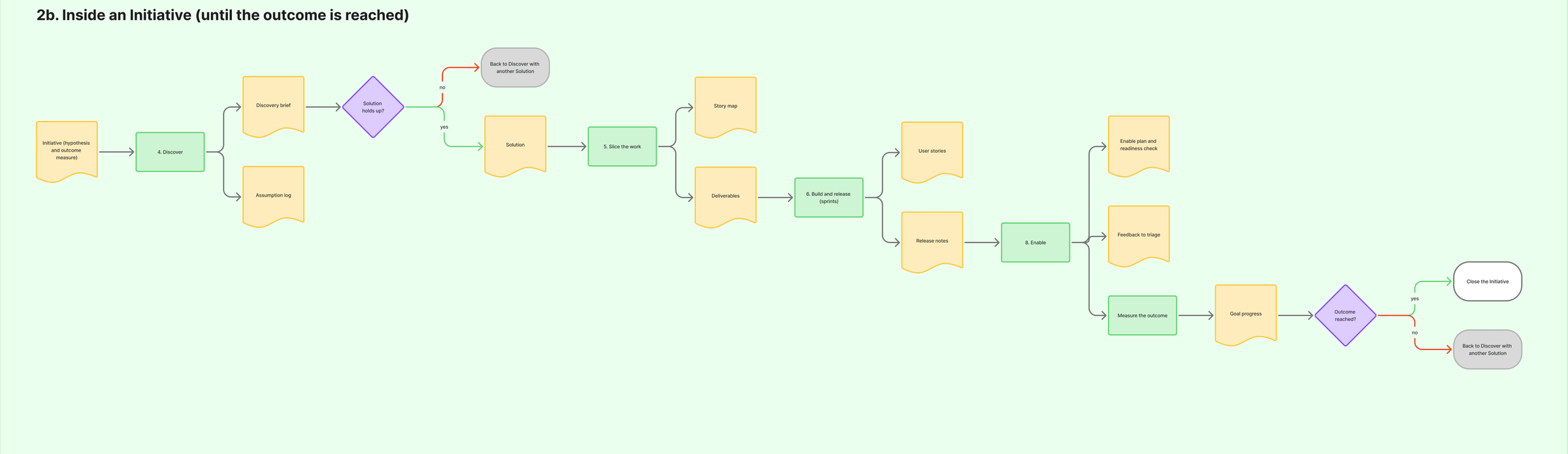
This document covers step 5, Slice the work. The team cuts a committed Solution into Deliverables that fit a quarter, then cuts each Deliverable into user stories that fit a sprint. Teams may group stories into epics however helps them. Every slice has to give a real person something they can use.
When
- Deliverables. Slice a Solution when it moves to Next. Quarterly planning schedules Deliverables into Now.
- User stories. Slice in refinement, every sprint. Keep about two sprints of ready stories ahead.
- Spikes. Whenever the team can't estimate a story because something is unknown.
Who
- Product manager sets the target outcome for each Deliverable and decides what goes in Now.
- Product owner facilitates mapping and slicing, writes stories and acceptance criteria, and accepts finished stories.
- UX designer and researcher brings users' steps and words, and owns design readiness.
- Development team splits, tasks out and estimates stories.
- Technical architect names dependencies and records architecture decisions.
- Scrum master keeps refinement moving and guards the definitions of ready and done.
- Content strategist joins when a story changes words or rules people read.
How it works
1. Map the Solution
Map with the people who did discovery, left to right in the order users act:
- Activities: big goals a user would say they finished. No technology. "Gather documents."
- Tasks: single actions under each activity, with a clear start and end. "Send a document for review."
- Details: the smallest buildable pieces, including variations and exceptions. Write them as what people accomplish, not what they click: "Know which documents count," not "See the documents list."
Activities and tasks form the backbone. Use users' words.
Check every detail with "so that what?" If the answer is "so they can click another button" or "so they can see something," rewrite it as an outcome. The same test sizes a detail: if splitting it gives pieces with the same "so that," it was one detail. Then review the details for five common mistakes and fix only what's broken:
| Mistake | Instead of | Write |
|---|---|---|
| Interface mechanics | "Tap map to set location" | "Specify pickup location" |
| A performance goal | "Load quickly" | What makes it fast, with the target as a note |
| A feeling | "Feel confident" | What creates the feeling: "Compare options side by side" |
| A vague aspiration | "Easy to understand" | The specific things that make it true |
| A design constraint | "Create without setup" | What enables it: "Created with sensible defaults" |
Coherence, not perfection. Gray areas are normal. Every activity on a map should feel like the same size of stage, every task the same size of action, every detail the same kind of buildable unit. If you're less than 90% sure which level something belongs at, ask rather than guess. That goes for people and for AI drafting a map.
2. Slice releases by target outcome
Draw lines across the map. Each slice starts with a target outcome: what people will be able to do once it ships. Move every detail that doesn't serve that outcome below the line. Leave activities in place even when nothing under them makes the slice.
A Deliverable is a tangible thing handed over, so a commitment can be checked as met or not (see the Glossary). When a Solution ships in releases, each Deliverable is a release slice scheduled into a quarter that works end to end for someone. Database this quarter and screens next quarter is a horizontal slice that nobody can use.
A learning slice tests the riskiest remaining assumption with real users, often by hand or behind a flag.
3. Group stories into epics, if it helps
An epic is a flexible container for related stories. There is no single right shape. Common ones:
- A column on the story map, such as "Check documents," which may span several quarters' Deliverables.
- A variation inside a slice, such as one document type.
- A whole slice, when a Deliverable is small enough to be one epic.
Pick what helps the team size, order and talk about its work, and stay consistent within a Solution. The one rule: an epic stays inside one Solution. Epics are optional and are not a link in the chain. Every story links to its Deliverable, which is what traces work to a goal and shows whether a commitment was met. Epics can be T-shirt sized at planning if that helps, but the commitment is sized and judged at the Deliverable. Older material puts a "feature" above the epic. That level is the Solution here.
4. Write user stories
Each detail in the current slice becomes one or more stories: "As a [specific user], I need to [action], so that I can [benefit]." The story is the smallest artifact we work from. If something won't fit the format, you haven't found the right artifact yet. It may be a task, a spike or a Deliverable.
Check every story against INVEST: Independent, Negotiable (what and why are clear, how is open), Valuable, Estimable, Small enough for a sprint, Testable. Write acceptance criteria as Given / When / Then scenarios.
5. Split stories vertically
Split by user path, never by layer: one document type at a time, the main path before exceptions, a simple version before a complete one. Two tests:
- Vertical slice test. Can you demo it to a real user and get useful feedback? If not, it's a horizontal piece.
- "So that" test. If two pieces share the same "so that," they were one story.
6. Refine in three phases
- Value known. Before refinement, the product owner writes the story, the why and the essential requirements.
- Solution known. In refinement, the team fleshes out the design, writes acceptance criteria and flags dependencies.
- Work known. The team breaks the story into tasks, splits it if needed and estimates it.
All the work a story needs lives in the story or its tasks.
7. Estimate at the right level
- Roadmap: T-shirt sizes (XS, S, M, L, XL) on Solutions and Deliverables (and on epics, if the team finds it useful), counted in sprints of focused work (see Quarterly planning and commitments).
- Team: story points are optional. If used: 1, 2, 3, 5, 8, 13. A story at 8 should be split; at 13 it must be. Points blend size, uncertainty and dependencies. Don't convert them to hours. Count design, content and testing, not only code.
8. Use spikes for unknowns
A spike investigates one specific, uncertain question. It is timeboxed to a few days and ends in something concrete: a decision, an architecture decision record or a prototype. A spike is not a user story. Its job is to make a story estimable.
Template
Use Deliverable, Epic (optional) and User story. The user story template holds the definitions of ready and done; review both at retrospectives.
DMV example
Story map for License Ready Check. Backbone: Find out what I need → Gather documents → Check documents → Book visit → Finish at the counter.
Deliverable: Pre-check for birth certificates and proof of address. Q3, size M. Filled in as the DMV example in Deliverable.
Later slices: all standard documents (Q4), then a name-mismatch flag linked to booking (Q1). Learning slice this quarter: staff handle name-mismatch cases by hand for 20 applicants.
The team grouped this Deliverable's stories by document type, so both stories below belong to the Birth certificate check epic. Grouping by map column would have worked too.
Story 1: Submit a birth certificate photo. Filled in, with acceptance criteria and the readiness notes, in User story. Privacy review came first, because document images are new data.
Story 2: Review a birth certificate
As a document reviewer, I need to see each uploaded birth certificate next to the rule that applies, so that I can accept or flag it in under two minutes.
- Scenario 1: Given a photo is in my queue, when I accept it, then the applicant sees "Accepted. Bring the original to your visit" and the item leaves my queue.
- Scenario 2: Given a photo is in my queue, when I flag it with a reason such as "souvenir copy, not state-issued," then the applicant sees the reason in plain language and what to bring instead.
The first version covered every document type and was estimated at 13, so the team split it by document type.
Rules of thumb
- A Deliverable someone can't use is a phase, not a slice.
- If you can't demo it to a real user, it wasn't sliced well.
- Keep skipped activities on the map. The gap shows what this release won't do.
- A spike answers one question by a date. Without both, it's open-ended research.
Files for this chapter
Blank template plus a filled DMV example for each.
Taught in
- How We Map and Slice the Work · Practice: mapping and slicing, 16 slides
- How We Run a Sprint · Practice: sprints and the sprint report, 21 slides
On the board