The system06Draft
Quarterly planning and commitments
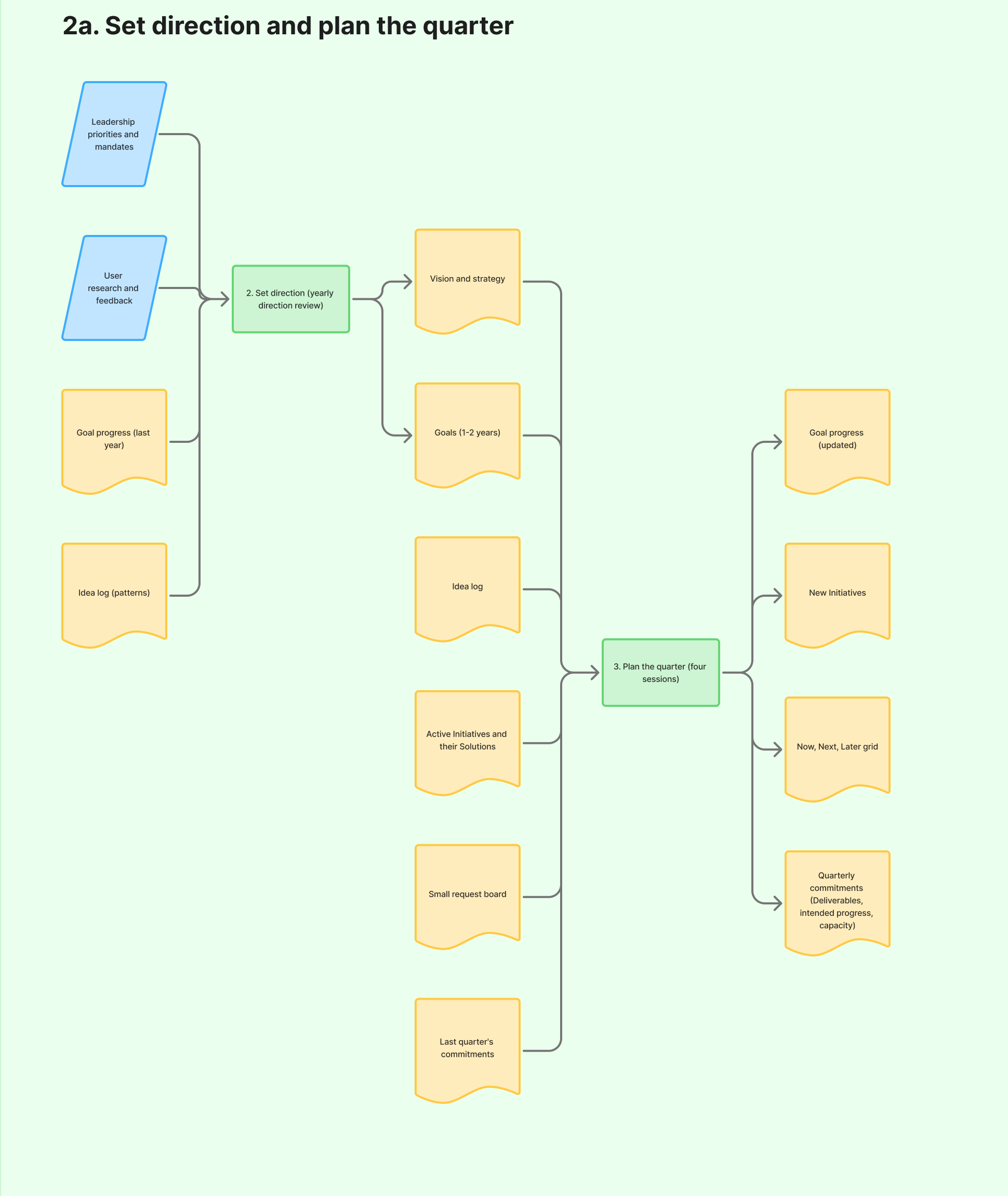
Quarterly planning is step 3 of the process flow. In one planning week the team turns the year's goals into work it believes it can finish in 12 weeks. It writes that work down as the Quarterly commitments section of the roadmap: what we promised, how much time we had, and what could get in the way.
When
- Before the quarter starts. Four half-day sessions spread across one week, with gaps between them for research and dependency work.
- Commitments lock on the first day of the quarter. Mid-quarter changes break the time math everyone committed against. New work waits for next quarter unless the product manager and steering group trade something out.
- Status updates each sprint, at sprint review: Committed, On track, Off track or Done.
- Goal progress updates at planning, on day 1, before anyone picks new work.
Who
- Product manager leads, brings the candidates, updates goal progress, and makes the hard cuts and the final call.
- Product owner brings the Small requests picture from triage and helps scope Deliverables.
- Scrum master facilitates sizing, keeps time, and runs the capacity math.
- Development team, UX designer and researcher, content strategist size their parts and commit out loud.
- Technical architect leads the Technical maintenance list and flags technical dependencies.
- Executive steering group receives the committed plan: what is in, what is out, and why.
How it works
The four sessions
- Strategy and candidates. The product manager walks through vision, strategy and goals, updates goal progress, reviews last quarter's commitments, and presents candidate Deliverables with the reason for each. Questions only: what problem does this solve, and what is the smallest useful version? Feedback on priorities is welcome and applies to future quarters. This week we scope, size and commit.
- Sizing. Groups size their assigned items, then the whole team reviews sizes, dependencies and confidence. Wide disagreement gets a second round.
- Technical maintenance and capacity. List the maintenance, security and support work that has to happen, and who owns it. Then do the math: sized work against available days. The product manager makes the cuts.
- Commitment. Review what fits, write the commitments section, and ask each person to commit out loud. Agree what goes to stakeholders.
Inside the planning week
The sessions above are the agenda. These are the moves that happen inside them.
- Before the week: break candidates into pieces you can size. The product manager shares the candidate Solutions and the slice of each wanted this quarter. The product owner and development team break each slice into smaller pieces (epics, if the team uses them) so there is something concrete to size.
- Session 1: candidates in priority order. The product manager presents the candidates as one ranked list, not a list per goal. The order is the product manager's call. The team asks questions; it doesn't re-rank.
- Session 2: size the pieces, then the Deliverables. T-shirt size the pieces, then check that each Deliverable's size matches its pieces added up. For the top-ranked work, break them into stories and point them if the team uses points. That surfaces hidden work while there is still time to cut.
- Session 3: count the days, then draw the cut-off line. First the capacity math (below). Then the scrum master lines up the ranked candidates and adds their sizes against the Strategic sprints available. Where the running total passes capacity, draw a clear line. Everything below it is out of this quarter. The product manager can swap items across the line, but can't move the line.
- Session 3: map release slices to sprints. Place each Deliverable's pieces across the six sprints. This shows ordering problems and dependencies the totals hide: two Deliverables that both need the same developer in Sprint 2, or a legal review that lands after the work that needs it.
- Session 4: vote of confidence. Everyone shows a confidence score from 1 to 5 at the same moment. Anyone at 1 or 2 says why, and the team cuts scope or fixes the plan until everyone is at 3 or above. Then each person commits out loud.
Capacity math
A full quarter is 13 weeks: 65 weekdays and six two-week sprints plus a spare week. Real capacity is always less. Work it out per person:
- Start with the quarter's weekdays.
- Take off holidays, planned vacation and big events the team must support, such as an election or a fiscal year close.
- Take off organization business: all-hands meetings, mandatory training, timesheets.
- Split what is left by this quarter's work types. Strategic days divided by 10 gives Strategic sprints, the number the fit check uses.
Do the math before the cut-off line, not after. A plan built on 65 days that the team doesn't have is a promise already broken.
Three work types
Every piece of work belongs to one type. Ask in order and stop at the first yes.
| Ask | Work type | Default share |
|---|---|---|
| Does it advance a roadmap goal? | Strategic (discovery and delivery) | 50% |
| Does it keep services running, healthy and secure, or help the team work better? | Technical maintenance | 25% |
| Is it a request triage sent to the small request board? | Small requests | 25% |
The split is set each quarter. Start from 50/25/25 and adjust to the work at hand: a fixed launch date may call for more Strategic, a system near end of life for more Technical maintenance. Write the split and the reason in the planning overview. Some teams differ for longer because of what they are. A team mostly doing discovery might run 70/15/15. A team that mostly runs existing services might run 20/50/30. A digital accessibility role trialed 20/50/30 because its compliance work was mostly maintenance. If a team keeps overriding the default the same way, that is a systemic signal: change its default and say why. Equal importance doesn't mean equal time. When maintenance work directly enables a roadmap item, pick one type for it and move on. Organization business, such as all-hands meetings, mandatory training and timesheets, is not a work type. Take it off the top before you count hands-on days.
Sizing: sprints of effort, not sprints on the calendar
A T-shirt size answers one question: how much focused work does this take for the people who will do it, counted in two-week sprints? Waiting, approvals and scheduling go into dates and dependencies instead.
- Getting staff feedback: send the email (5 minutes), wait two weeks, hold the session (1 hour). The size is 1 hour 5 minutes. The two weeks go on the calendar.
- A translation API integration: write it (4 hours), test it (2 hours). Google's 200-millisecond response doesn't count. The size is about 6 hours.
| Size | Focused work |
|---|---|
| XS | A few hours |
| S | One sprint or less |
| M | About 2 sprints |
| L | 3-4 sprints |
| XL | 5 sprints or more. Fine for a Solution; a Deliverable this size must be sliced. |
Why an XL splits. A quarter has 6 sprints. At the default 50% Strategic, each person has about 3 sprints for Strategic work (about 3.5 at 60%). An XL can't finish inside one quarter, so it's a Solution, not a Deliverable. Slice it (see Deliverables and user stories). An L fits, but only just, so check its dependencies hardest.
Fit check. For each person or pair, add up the sizes they own and compare the total with their Strategic sprints. Anyone over budget means something gets cut.
T-shirt sizes go on the roadmap because stakeholders can read sprints. Story points are optional inside the team. An older eGov scale tied sizes to points (S 1-3, M 5-8, L 13-20, XL 40+). Use points for stories, not for roadmap items.
What a commitment means
A commitment is a promise to try. You commit when you believe that, with focus, you can do your part without working extra hours. Some misses are assumed and nobody gets in trouble for one. The ask is to raise risks early. Commitment also asks for trust: size honestly with no sandbagging, assume positive intent, and trust the product manager's strategic calls.
Template
Use Roadmap, section 4, Quarterly commitments: the planning overview, one intended progress card per goal, ongoing commitments and planning notes.
DMV example
The filled DMV Q1 commitments (planning overview, the three intended progress cards, ongoing commitments and planning notes, with statuses as of the Sprint 3 review on Feb 14) are section 4 of the DMV example in Roadmap. Two moments from that planning week:
Cut-off line: the ranked list had five candidates. The line fell after the Staff Training Program. Renewal reminders by text (S) fell below it and went back to the idea log for Q2 planning.
Vote of confidence: two developers voted 2 on User Interface because of the legal approval. The team kept it in, named the Feb 21 approval date as a dependency, and agreed the product manager would escalate if it slipped. The revote was all 3 or above.
Rules of thumb
- Size the effort, not the wait. When someone says "this needs a lot of coordination," ask how the coordination changes the work, then put the waiting on the calendar.
- Calibrate sizes against your own past work after each quarter.
- Teams new to planning don't know how to commit yet. We can all be bad at it, and the first quarter can fail. Doing it anyway builds the habit, and the next one won't be so bad.
- Don't skip the maintenance session. One of our first quarterly plannings gave it one hour, and the team was soon consumed by roadmap work while the foundation slipped.
- An XL Deliverable is a question, not a size. Split it, or check whether it is really a Solution.
- Write intended progress before you lock the commitments. If no goal is expected to move, ask why we are doing the work.
- The cut-off line is the most useful thing planning produces. Saying out loud what didn't make it is what makes the rest believable.
- A low confidence vote is information, not dissent. Fix the plan, not the person.
Files for this chapter
Blank template plus a filled DMV example for each.
Taught in
- How We Plan the Quarter · Practice: quarterly planning, 19 slides
On the board